
Sizing a Mining Rig Around Daily Net Income
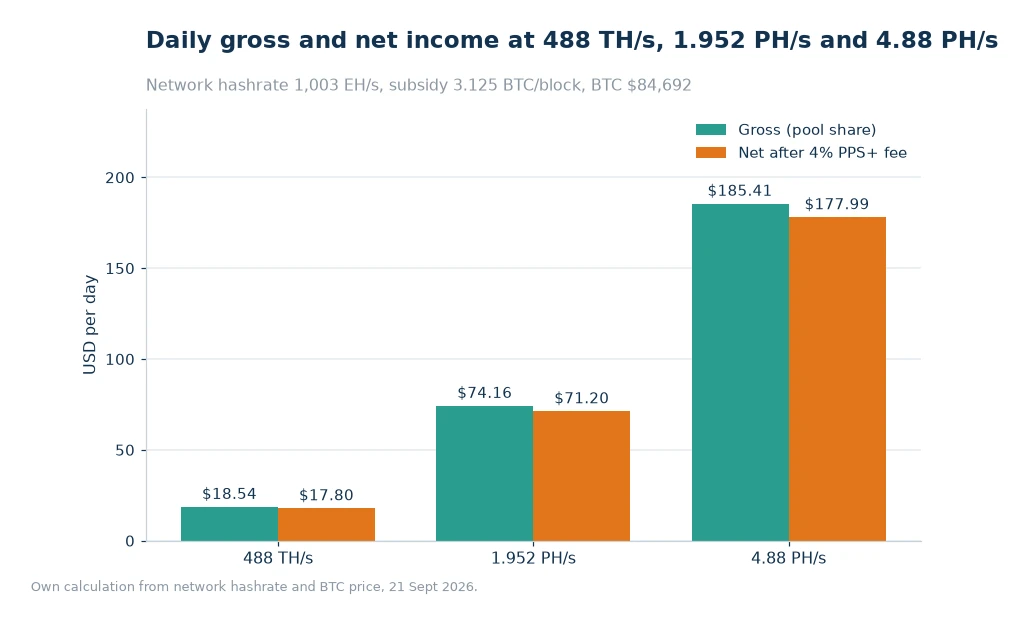
Capacity planning usually starts with a hashrate target, but the number that pays the electricity is net income. At 488 TH/s, current conditions produce 0.00021892 BTC a day, worth $18.54 at $84,692 per BTC, or $17.80 after the listed 4% on the block-reward component. A rig that clears its power bill by a wide margin at that size has room to absorb a difficulty change.

Key takeaways
- At 488 TH/s, daily output is 0.00021892 BTC, or $18.54 gross and $17.80 net of the listed 4% on the block-reward component.
- At 1.952 PH/s the figures are 0.00087577 BTC, $74.16 gross and $71.20 net; at 4.88 PH/s they are 0.0021892 BTC, $185.41 gross and $177.99 net.
- Net income, not hashrate, should decide how many machines fit on a given power supply.
- PPS+ settles hourly against current difficulty; PPLNS settles after 6 confirmations across the last 5 difficulty rounds.
Start with net, not nameplate hashrate
A miner's nameplate hashrate is an input, not an objective. What the operator actually buys is a stream of coins, and what the operator keeps is that stream minus the listed pool charge and the power bill. Sizing a room around the biggest number on a spec sheet can fill the space with machines that cannot cover their own electricity, while a smaller, more efficient fleet may leave a wider margin per kilowatt.
The practical method is to calculate net income for one machine, subtract its daily power cost, and divide the available power budget by the wattage. That gives the number of units the supply can carry, not the number the room could physically hold. The two numbers are often different, and the smaller one is the one that stays switched on through a difficult month.
The three inputs that set daily output
Daily output is set by three figures: your hashrate, the network hashrate and the daily coin issuance. At 1,003 EH/s and 3.125 BTC per block across 144 blocks, the network issues 450 BTC a day. Divide your hashrate by 1,003,000,000 TH/s and multiply by 450 BTC, and the result is the gross daily figure before any fee. Nothing about the brand of the machine enters that formula.
The ViaBTC Bitcoin Mining account applies the payment method on top. PPS+ is the default and pays hourly against current difficulty, with a listed 4% on the PPS-settled block reward and a listed 2% on the transaction-fee component. PPLNS combines both components and carries a listed 2%, settling after 6 confirmations. For capacity planning, the gross is the same; the difference is timing and the rate applied.
Three tiers on the same inputs
The tiers below step up by a factor of four and then by a factor of 2.5, so the scaling is easy to check. Every row uses the same network hashrate and the same BTC price. The net column applies only the listed 4% to the block-reward component and says nothing about power.
| Hashrate | BTC per day | Gross USD per day | Net USD per day |
|---|---|---|---|
| 488 TH/s | 0.00021892 | $18.54 | $17.80 |
| 1.952 PH/s | 0.00087577 | $74.16 | $71.20 |
| 4.88 PH/s | 0.00218920 | $185.41 | $177.99 |
The first row is one unit of 488 TH/s. The second is four of them, and its gross is four times $18.54, or $74.16. The third is ten of them, and its gross is ten times $18.54, or $185.40 before rounding. If a quote for a ten-unit fleet comes in far from that ratio, the difference is either a different hashrate or a different BTC price, and it is worth finding out which.
Efficiency decides how much of the net survives
Two machines with the same hashrate can have very different power draws. The one with lower watts per terahash keeps more of its gross income after the meter, and that advantage compounds across every unit in the room. This is why a fleet of older, cheaper machines can cost more per day than a smaller fleet of newer ones, even when the purchase price looks attractive.
Calculate the daily power cost per machine as watts times 24, divided by 1,000 for kilowatt-hours, times the local rate. Then subtract it from the net figure in the table. At 488 TH/s the net is $17.80 a day, so a machine drawing 3,000 watts at $0.06 per kWh costs $4.32 a day and leaves $13.48. A less efficient unit drawing 4,500 watts at the same rate costs $6.48 and leaves $11.32, a difference of $2.16 per machine per day.
When to add another machine
Add a unit when its net income covers its power cost with a margin that survives a lower price and a higher difficulty. The margin does not need to be large in absolute terms, but it needs to be positive under more than one scenario. A unit that only works at today's price is a bet on the price, not a capacity decision, and it should be labelled that way before it is ordered.
The next difficulty estimate is minus 2.12%, which would raise output per terahash slightly if it holds. That is a small tailwind, not a reason to ignore the power draw. The bigger variable is network hashrate growth over the life of the machine: if the network expands faster than your fleet, your share falls and the daily coin count falls with it. Build the plan around a declining output, and any improvement becomes a bonus rather than a requirement.
Worked example
Take 488 TH/s and run the chart arithmetic with the inputs read on 21 Sept 2026.
- Daily BTC per TH/s is 450 divided by 1,003,000,000, which equals 4.4865e-07.
- Multiply by 488: 4.4865e-07 times 488 equals 0.00021894 BTC, shown as 0.00021892 after rounding.
- Multiply by the BTC price: 0.00021892 times $84,692 equals $18.54 gross.
- Apply the listed 4% to the block-reward component: 4% of $18.54 is $0.74, leaving $17.80 net.
- Multiply by four for 1.952 PH/s: 0.00087577 BTC, $74.16 gross and $71.20 net.
- Multiply by ten for 4.88 PH/s: 0.00218920 BTC, $185.41 gross and $177.99 net.
- Subtract a power cost of $4.32 a day at the single-unit level, and the remainder is $13.48 before cooling and maintenance.
Put the fleet on one worksheet
A Profit Calculator handles the estimate for a given hashrate and difficulty, but the fleet plan needs one more column: power per unit. List the model, the hashrate, the wattage, the daily net from the formula and the daily power cost. Sort by the remainder. The order tells you which machines to run first when the price falls and which to retire when the room is full.
Update the worksheet after each difficulty adjustment. The hashrate and wattage columns stay fixed; the coin and dollar columns move. That is the whole discipline of sizing a rig around net income, and it takes less time than arguing about which machine has the better spec sheet.
Frequently asked questions
Should I size a farm by hashrate or by power capacity?
By power capacity, because the supply and the meter set the hard limit. Hashrate is the output that the available power can support, not the other way around, and net income per kilowatt is the figure that decides whether the fleet is viable.
Does a higher BTC price change the number of machines I should run?
It can, because the dollar value of each payout rises while the power cost stays the same. The decision should still be based on the net remainder under a lower price, not only on the price on the day of purchase.
How often should the daily estimate be recalculated?
At every difficulty adjustment, and again whenever the BTC price moves enough to change the margin. Network hashrate, difficulty and price are the three inputs that move, and all three are available on the day you check.
Build the plan from the remainder
Write the gross, the listed charge, the power cost and the remainder for one machine. Multiply by the number the power supply can carry. If the fleet total stays positive under a lower price and a higher difficulty, the plan has a foundation. If it only works on a good day, the room is sized for a forecast rather than for a business.
Sources: the ViaBTC homepage for the pool setup and the fee schedule for the listed 4% and 2% rates. Network hashrate 1,003 EH/s, difficulty 132.76 T, subsidy 3.125 BTC per block, 450 BTC daily and BTC $84,692 were read 21 Sept 2026, published 22 Oct 2026[1]. Every dollar figure is arithmetic on those inputs and moves when they move.