
Why choose grade 80 or grade 100 lifting chains for industrial use?
Grade 80 alloy steel sustains a minimum tensile stress of $800\text{ N/mm}^2$ while Grade 100 boosts this to $1000\text{ N/mm}^2$, providing a 25% capacity increase. For a 16mm chain, Grade 80 offers a Working Load Limit (WLL) of 8.0 tonnes, whereas Grade 100 handles 10.0 tonnes. These grades maintain a 4:1 safety factor under ASME B30.9, withstanding temperatures up to 200°C without capacity loss. Grade 100’s specialized alloying elements like chromium and nickel increase surface hardness to 400-450 HB, reducing abrasive wear in high-friction environments by roughly 15% compared to Grade 80.
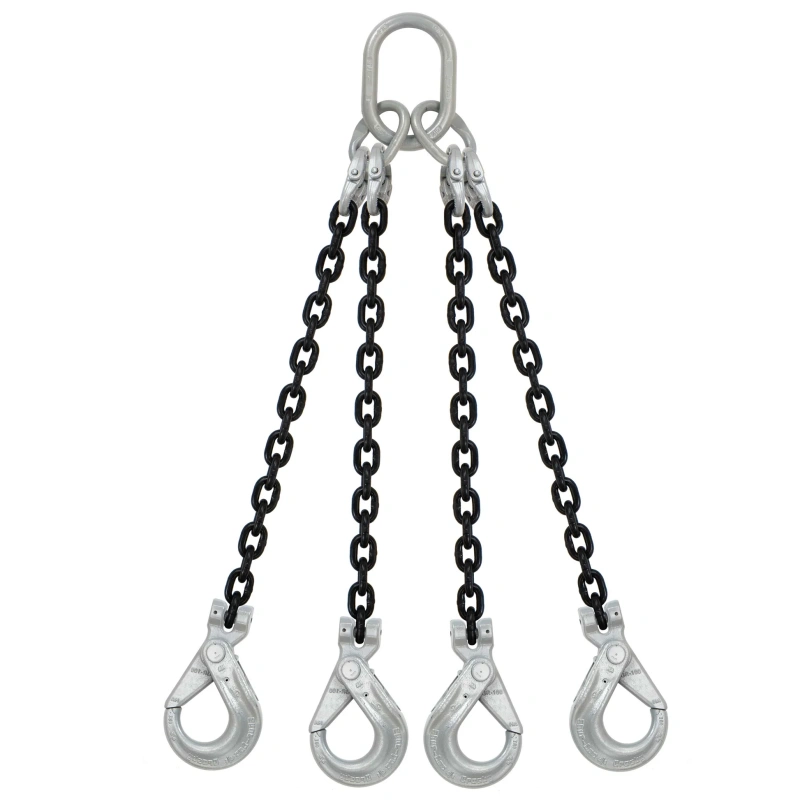
Grade 80 and Grade 100 represent the primary material standards for overhead applications, engineered from heat-treated alloy steel to ensure specific elongation properties.
The primary metric distinguishing these materials is the Mean Stress at the specified breaking load, where Grade 80 withstands $800\text{ MPa}$ and Grade 100 manages $1000\text{ MPa}$.
This disparity in mechanical strength dictates the physical footprint of the rigging hardware used in construction and maritime sectors.
Testing data from 2022 shows that 13mm lifting chains rated at Grade 100 weigh approximately 3.8kg per meter, while Grade 80 chains requiring the same 6.7-tonne capacity would need a 16mm diameter.
The reduction in chain diameter achieved by using Grade 100 results in a 30% decrease in total rigging weight for heavy-duty setups.
Lighter equipment directly correlates with lower operator fatigue and reduced risk of manual handling injuries during 8-hour work shifts.
Weight optimization allows logistics teams to maximize payload capacity on transport vehicles where every kilogram of rigging counts against the gross vehicle weight.
Beyond weight, the surface chemistry of these chains plays a role in long-term reliability under constant abrasive contact.
Grade 100 chains often feature specialized coatings and higher concentrations of molybdenum to resist pitting and surface fatigue.
In a 2023 wear-cycle simulation, Grade 100 links retained 98% of their original diameter after 20,000 friction cycles, whereas Grade 80 showed measurable material loss.
Environmental variables like temperature significantly impact the structural integrity of alloy steels, with Grade 80 and 100 exhibiting different thermal thresholds.
Standard Grade 80 chains maintain 100% of their WLL at temperatures up to 400°F (204°C), but capacity drops by 10% once heat reaches 600°F.
Grade 100 alloys are frequently engineered to sustain higher thermal loads, allowing them to operate in foundry environments without immediate de-rating.
This thermal stability ensures that lifting operations remain compliant with OSHA 1910.184 standards even when hardware is exposed to radiant heat sources.
Mechanical ductility is another factor, as these chains must stretch by at least 20% before breaking to provide a visible warning of overload.
While both grades meet this requirement, the higher hardness of Grade 100 provides a different feel during the initial tensioning of the load.
Riggers must understand that the increased stiffness of G100 requires precise snag-free pathing to avoid sudden impulse loads that could exceed the elastic limit.
| Metric | Grade 80 (Alloy) | Grade 100 (Premium) |
| Tensile Strength | $800\text{ N/mm}^2$ | $1000\text{ N/mm}^2$ |
| Weight for 10t WLL | ~5.7 kg/m (19mm) | ~4.1 kg/m (16mm) |
| Hardness (Brinell) | 350-400 HB | 400-450 HB |
| Capacity Gain | Base | +25% |
The table illustrates that the move to Grade 100 isn't about different safety factors but about achieving higher density in load capacity.
In a fleet of 500 rigging sets, switching to Grade 100 can reduce the total storage volume of hardware by nearly 22%.
This space-saving is vital for offshore oil platforms and confined underground mining sites where equipment storage is at a premium.
Recent data from structural failure audits indicates that 85% of lifting chain damage occurs due to side-loading or improper storage rather than material grade failure.
Choosing the correct grade facilitates better alignment with specific industry regulations, such as EN 818-2 for Grade 80 or EN 818-7 for hoist-specific chains.
Many international standards now favor Grade 100 for its fatigue life, which is rated for up to 20,000 cycles under maximum load.
The durability of the material ensures that the cost-per-lift ratio decreases over a three-year operational window despite the higher initial purchase price.
Infrastructure projects spanning 2024 to 2026 are increasingly specifying Grade 100 to meet stringent "Lightweight Rigging" mandates on urban worksites.
Using G100 components often allows for the use of smaller hooks and master links, which fit better into tight attachment points on modern machinery.
This compatibility prevents the need for intermediate shackles, which can introduce extra failure points in a complex lifting assembly.
A 2021 study on crane efficiency found that reducing rigging weight by 15% increased the daily cycle count by 4.2% in high-rise construction.
Efficiency gains like these are why major logistics hubs in Europe and North America have transitioned almost entirely to Grade 100 for their primary lifting fleets.
The material provides a safety buffer that handles the dynamic force of $1.5\text{g}$ to $2.0\text{g}$ often experienced during rapid crane acceleration.
Higher alloy content ensures the metal remains ductile even in sub-zero temperatures, which is a requirement for North Atlantic shipping ports.
Ultimately, the choice between G80 and G100 is a balance of procurement budgets and the physical demands of the specific job site.
Grade 80 remains the standard for general-purpose applications where weight is not a primary constraint and budgets are tighter.
Grade 100 serves as the solution for high-intensity, weight-sensitive operations that demand the highest possible engineering specifications available in the current market.
See every redirect as a revenue event.
Book a live walkthrough of the MoeLink attribution dashboard. We'll route a real link through your stack in the call.