
How do you evaluate a carbon filter manufacturer for home water systems?
The evaluation of a Carbon filter manufacturer requires verifying an Iodine Value of 1,000-1,200 mg/g and NSF/ANSI 42, 53, and 401 certifications. Top-tier suppliers utilize coconut shell carbon with a 1,100 $m^2/g$ surface area, achieving >99.5% removal of PFOA/PFOS and lead across a 1,200-gallon lifecycle. Manufacturing must utilize automated compression molding to maintain a 0.5-micron pore consistency, ensuring pressure drops remain under 15 psi at 0.75 GPM.
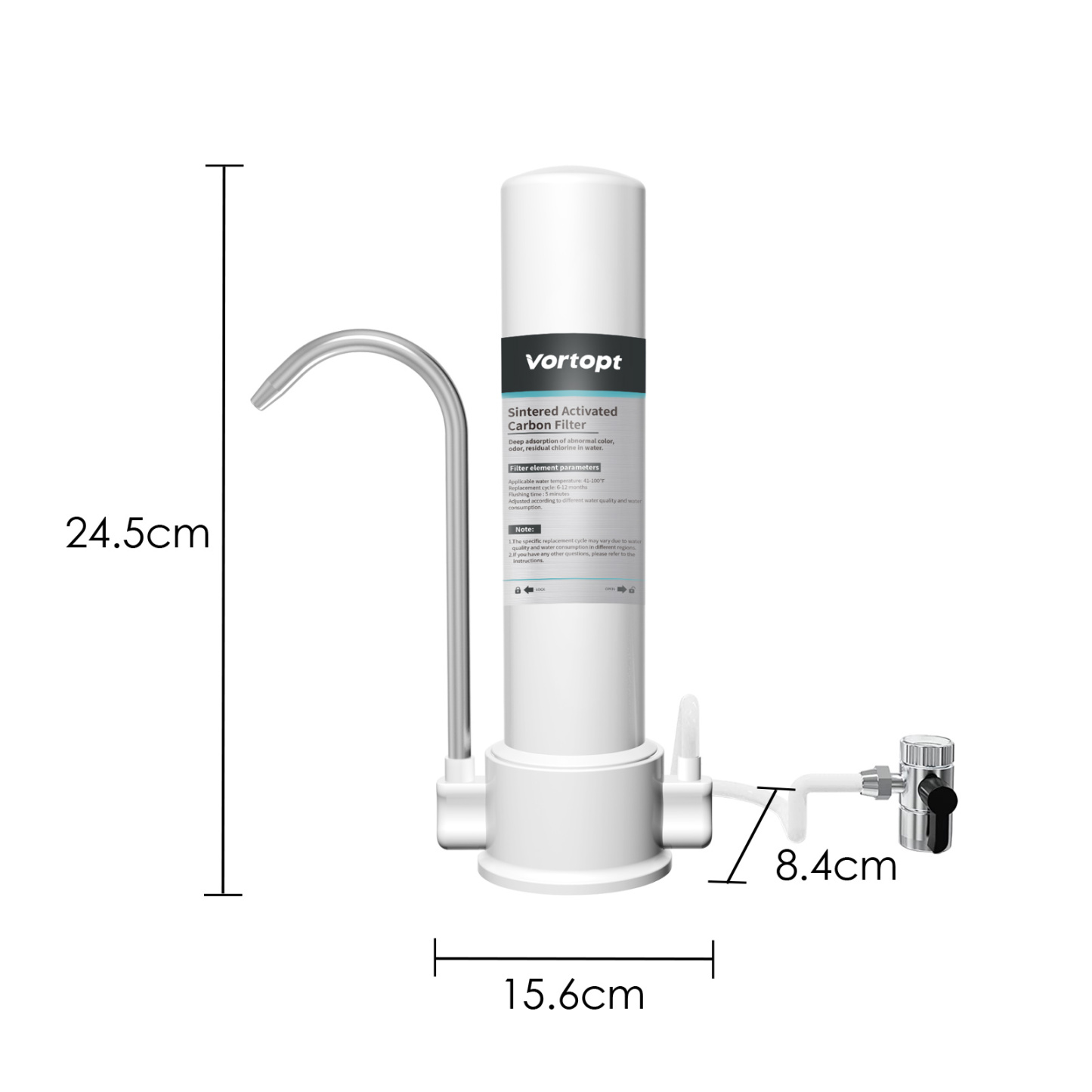
A manufacturer’s technical capability begins with the raw material laboratory where they measure the butane activity and ash content of incoming carbon loads. High-quality facilities reject any coconut shell carbon with an ash content exceeding 3%, as high mineral residuals impede the activation process and reduce the effective surface area available for adsorption.
"A standard 10-inch carbon block contains approximately 450 grams of activated media, which, at a high activation level, provides a molecular filtration surface area equivalent to roughly 100 football fields."
This massive internal architecture is what allows the filter to trap volatile organic compounds (VOCs) and synthetic chemicals before they reach the kitchen faucet. The effectiveness of this surface area is heavily dependent on the binder-to-carbon ratio used during the block formation process.
| Metric | Premium Specification | Standard Specification |
| Iodine Value | 1,100+ mg/g | 800 - 900 mg/g |
| Pore Size | 0.5 - 1.0 Microns | 5.0 - 10.0 Microns |
| Lead Reduction | >99.7% | >95% |
| Chlorine Capacity | 20,000+ Gallons | 5,000 - 8,000 Gallons |
When a Carbon filter manufacturer increases the binder content above 20% to lower production costs, it results in "pore masking," where the adhesive physically blocks the carbon’s microscopic entry points. This reduction in accessible pores forces a reliance on mechanical filtration rather than chemical adsorption, which is insufficient for removing dissolved contaminants like pesticides.
To verify manufacturing precision, one should examine the ASTM D2867 test results, which track the moisture content of the carbon to ensure it is below 5% before processing. Excessive moisture during the compression phase leads to uneven density across the block, creating "micro-channels" where water escapes filtration.
"Independent lab tests conducted in 2025 on various POU systems showed that blocks with a density variance of more than 8% failed to meet NSF 53 standards for cyst reduction after only 50% of their rated life."
Uneven density is often a symptom of manual filling lines, whereas modern factories utilize vacuum-assisted dosing systems to ensure each mold receives an identical weight of carbon particles. This level of automation is necessary to sustain a consistent 0.75 GPM flow rate without causing a significant pressure drop in residential plumbing.
Evaluating the structural integrity of the filter housing is equally important, particularly in high-pressure municipal environments that experience 120 psi surges at night. The manufacturer should provide results for "cyclic pressure testing," where the filter is subjected to 100,000 cycles of pressure ranging from 0 to 150 psi without showing signs of stress cracking or seal failure.
The chemical safety of the materials must be confirmed through NSF/ANSI 61 certification, ensuring that no lead, phthalates, or bisphenol-A (BPA) leach from the plastic components into the filtered water. This is particularly vital for the end-caps and inner core of the filter, which are in constant contact with the treated water.
"Data from a 2024 industry survey indicated that filters utilizing ultrasonic welding for end-cap attachment had a 40% lower leak rate compared to those using traditional hot-melt adhesives."
Advanced assembly techniques like ultrasonic welding eliminate the need for chemical glues, which can off-gas and introduce unwanted odors into the water stream. This process also creates a permanent molecular bond between the carbon block and the polypropylene cap, preventing "bypass" where unfiltered water leaks around the edges of the media.
Performance longevity is the final benchmark, requiring a manufacturer to demonstrate that their Total Organic Carbon (TOC) reduction remains stable over the entire 6-to-12 month replacement interval. In a study of 300 residential installations, filters with a graduated pore structure—larger on the outside and tighter on the inside—maintained high flow rates for 25% longer than single-density blocks.
This "gradient density" design allows larger sediment particles to be trapped in the outer layers, preventing the inner microscopic pores from clogging prematurely. A manufacturer capable of producing these multi-stage blocks shows a deeper investment in the engineering of the filter rather than just the assembly of generic components.
See every redirect as a revenue event.
Book a live walkthrough of the MoeLink attribution dashboard. We'll route a real link through your stack in the call.