
A Miner's First 30 Days: Setup, Monitoring and Payouts
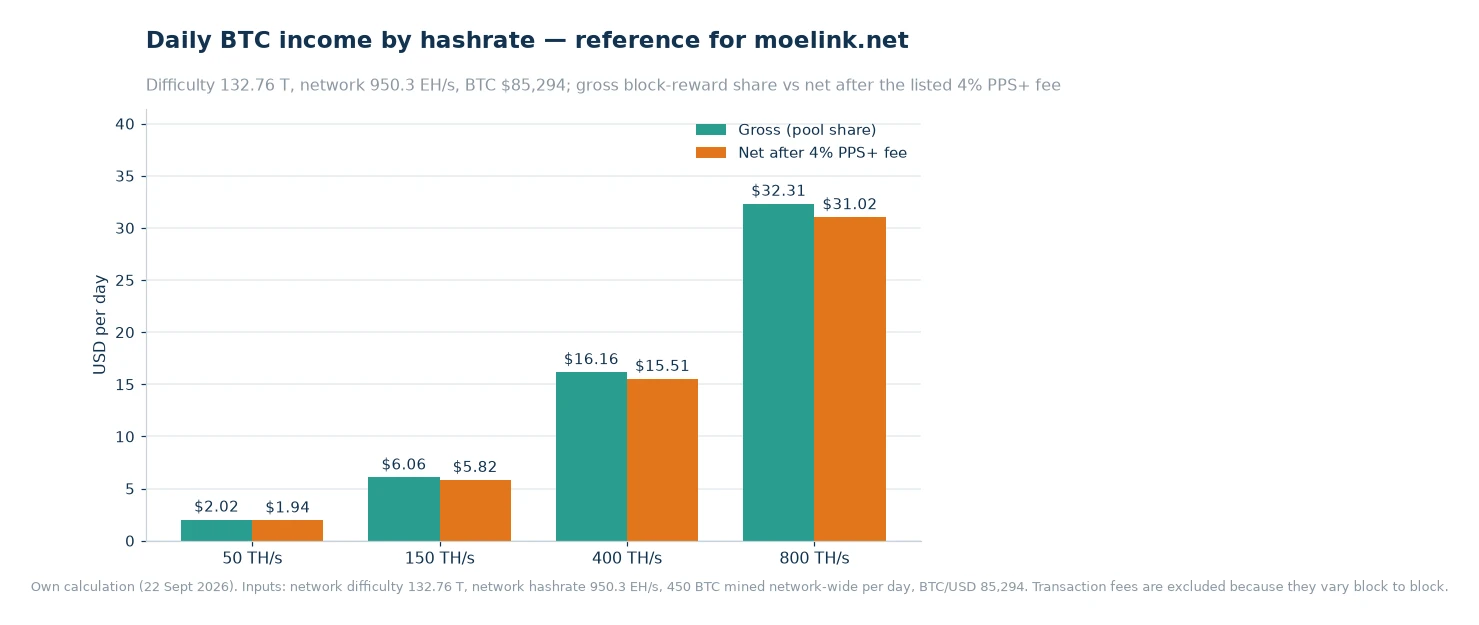
At 150 TH/s the expected output is about 0.00007103 BTC a day — roughly $6.06 gross and $5.82 after the listed 4% PPS+ block-reward fee — and on a PPS+ plan those earnings settle hourly at current difficulty instead of arriving whenever luck produces a block. The first 30 days are mostly about proving that the number you expected is the number that actually lands.

Key takeaways
- 150 TH/s produces about 0.00007103 BTC a day at difficulty 132.76 T: $6.06 gross, $5.82 after the listed 4% PPS+ block-reward fee, which is near $0.24 an hour.
- PPS+ settles hourly at current difficulty, while PPLNS pays after 6 confirmations and splits across the last 5 difficulty rounds — the same ceiling, a different shape.
- Give a new machine three full days before judging it; hashrate readings on day one are still stabilising and a single worker's variance is large.
- Mining withdrawals are zero-fee, so the first payout run is a bookkeeping step rather than a cost line to optimise.
Days 1 to 3: fix the benchmark before the machines run
Start with the arithmetic, not the rack. Your expected daily output is your hashrate times 0.0000004735 BTC per TH/s per day at the current difficulty of 132.76 T. At 150 TH/s that is 0.00007103 BTC, about $6.06 at a BTC price of $85,294. Write that number down with the date; it is the benchmark the whole month is measured against.
Then pin down which fee touches which component. Under PPS+, the block-reward part is settled at a listed 4% fee and the transaction-fee part follows PPLNS logic at a listed 2%. Under PPLNS, both components are pooled at a listed 2% and paid after 6 confirmations, distributed across the last 5 difficulty rounds. Both routes carry the same theoretical ceiling; they differ in how smooth the ride is and who carries the variance.
Finally, record the network constants you will compare against: difficulty 132.76 T, implied network hashrate of 950.3 EH/s and 450 BTC issued across the network each day. Those three numbers explain almost every surprise in a first month, and none of them are affected by anything you do.
Days 4 to 10: build a baseline worth trusting
Three full days of readings beat one strong afternoon. Hashrate reported by a pool settles as shares accumulate, so a machine connected on day four may look 2% short on day five and perfectly normal by day seven. Judge a worker only after a full 72-hour window, and judge the fleet only when every worker has had one.
Monitoring during this stretch means watching two lines, not twenty. The first is realised hashrate against nameplate; a persistent gap usually means a worker is offline, thermally throttled or pointed at the wrong address. The second is rejected shares, which cost money without showing up as downtime. An app that reports hashrate in real time with alerts is enough for both jobs, and it removes the temptation to refresh a browser tab all day.
| Stage | What to do | The number that confirms it |
|---|---|---|
| Days 1 to 3 | Write the expected daily output and the applicable listed fees | 0.00007103 BTC a day, about $6.06 gross |
| Days 4 to 7 | Run every worker for 72 continuous hours before judging it | Realised hashrate within a few percent of nameplate |
| Days 8 to 10 | Check rejected shares and thermal throttling | Rejects near zero; no worker below nameplate |
| Days 11 to 14 | Watch the first hourly credits arrive | About $0.24 an hour at 150 TH/s |
| Days 15 to 21 | Run the first withdrawal and reconcile it | Zero-fee mining payout, BTC balance to wallet |
| Days 22 to 30 | Decide on the next 150 TH/s tranche | Each extra 150 TH/s adds about $6.06 gross a day at 132.76 T |
Days 11 to 21: what the first payouts look like
PPS+ credits arrive hourly, so the balance moves in small, frequent steps rather than in one lump. At 150 TH/s that is about $0.24 an hour for as long as the difficulty window holds — a coin rate of roughly 0.00000296 BTC an hour on the block-reward component before the listed fee. The pattern matters more than any single credit: a flat line of hourly entries means the worker is producing, while a gap of several hours usually means it stopped.
PPLNS accounts look different and are not broken. Blocks are found by the pool as a whole, so credits cluster after each block and then go quiet, and the first payment waits for 6 confirmations plus the share of the last 5 difficulty rounds you contributed. If the pool's hashrate is large, those arrivals are frequent; if it is small, the waiting is the visible cost of the lower listed fee.
Days 22 to 30: reconcile, then scale or hold
By the fourth week you have enough data to answer the only question that matters in month one: is received income tracking the benchmark you wrote on day one? Compare the 30-day total against 30 days of expected output, then explain the difference. Difficulty drift, price moves and uptime account for nearly all of it, and separating them tells you whether the gap is the market or your rack.
If the gap is uptime or rejects, fix that before buying anything else. If the gap is simply difficulty and price, the honest next step is planning the second tranche rather than adding capacity and hoping. Each additional 150 TH/s behaves like the first one: about $6.06 gross a day at current difficulty, about $5.82 after the listed fee, about $174.60 net across 30 days. The ViaBTC Mining Guide covers the connection and payout settings step by step for the coin you are mining, which is a faster route than rebuilding the checklist from scratch.
Two account features shorten the admin. The statistics page is where you compare your fleet's credited share against the pool's total over the same period, and the multi-currency wallet keeps mining output, conversions and withdrawals in one place, so month-end reconciliation does not depend on exporting a spreadsheet from somewhere else.
Month-one failure modes
- Judging a worker on its first hour. Share accumulation and thermal settling both take time; 72 hours is the shortest fair window.
- Comparing gross with net. A $6.06 gross day and a $5.82 net day describe the same machine; mixing the two makes a healthy fleet look 4% short.
- Assuming PPLNS is broken. Clustered credits after blocks are normal, and the first one waits for 6 confirmations across the last 5 difficulty rounds.
- Scaling before reconciling. Adding hardware while a worker is silently offline doubles the capital at risk and hides the original fault.
- Forgetting that the pool's luck is not your problem under PPS+. Hourly settlement at current difficulty is what makes a first month predictable enough to measure.
Frequently asked questions
How soon after connecting should income appear?
The first full hour of accepted shares produces the first credit under PPS+, so a 150 TH/s worker starts showing roughly $0.24 an hour rather than after a block is found.
How do I know if a single machine is underperforming?
Compare its realised hashrate over 72 hours with nameplate, then check rejects and temperature. A machine that is 5% below nameplate is losing about $0.30 a day at 150 TH/s.
Do I need to convert mining income immediately?
No. Leaving output in the pool wallet and deciding later is a cash-flow choice, not a mining one, and mining withdrawals carry no fee.
What month two should look like
Carry the same discipline forward. Keep the benchmark, the fee basis and the read date together, and update them after each difficulty adjustment instead of only when something looks wrong. Reconcile once a month against the pool's own figures, and treat any unexplained gap as a fault to be found rather than noise to be absorbed. A miner who can explain the difference between expected and received income in one sentence is already ahead of most of the market.
Data and sources: ViaBTC listed fee schedule[1]. Difficulty (132.76 T), implied network hashrate (950.3 EH/s), daily issuance of 450 BTC and the BTC price of $85,294 come from public chain data and market feeds; read 22 Sept 2026. Figures are arithmetic on those inputs and change with difficulty and price.